Tirzepatide Bac Water Ratio How much bac water to mix with 30 mg tirzepatide
How much BAC water to mix with 30 mg tirzepatide
If you’re preparing tirzepatide and wondering about the tirzepatide bac water ratio, you’re not alone—this is one of the most common questions I hear from patients and pharmacy techs. Getting the concentration right matters for consistency, accuracy, and confidence in your dosing. In this guide, I’ll walk you through how to calculate the exact amount of BAC water to mix with 30 mg tirzepatide, including practical examples, common ratios, and a safety-first checklist.
Important: Follow your prescribing clinician’s instructions for dosing and concentration. Mixing instructions below are for calculation and clarity, not to replace medical guidance.
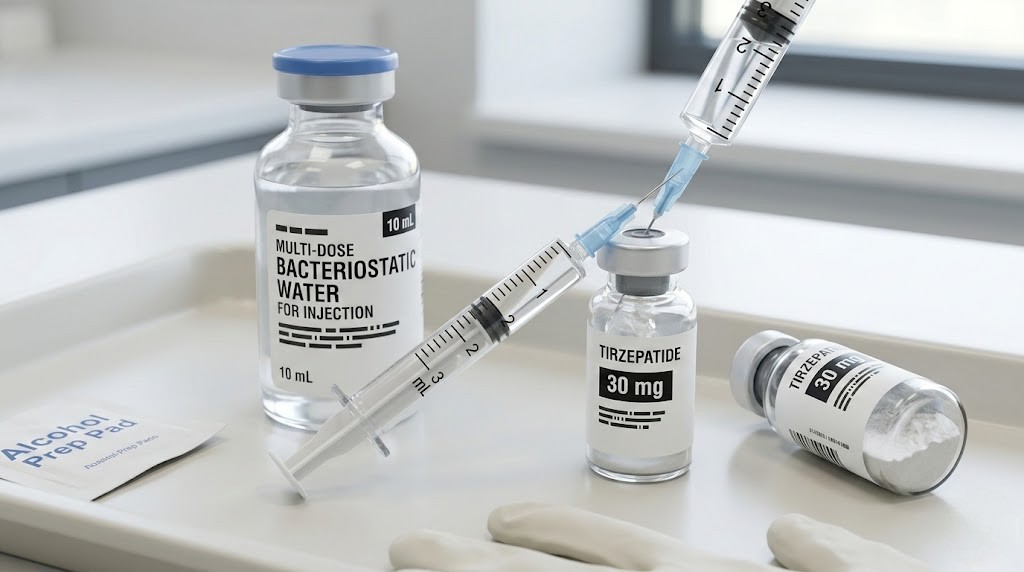
What “BAC water ratio” actually means (the concentration)
When people say “bac water ratio,” they usually mean the final concentration you create after adding bacteriostatic water (BAC water) to a tirzepatide vial.
In practice, you’re deciding:
- How many mg of tirzepatide you’re dissolving (here: 30 mg)
- How many mL of BAC water you add (this determines concentration)
- How many mg (or mL) you will withdraw per dose afterward
The math is straightforward:
Concentration (mg/mL) = Total tirzepatide dose (mg) ÷ Total volume (mL)
Once you know the concentration your plan requires (or the one your clinician/pharmacy specified), the volume of BAC water is just:
BAC water volume (mL) = Total tirzepatide (mg) ÷ Target concentration (mg/mL)
How to calculate BAC water amount for 30 mg tirzepatide
Because BAC water amount depends on your target concentration, the best way to answer “how much to mix” is to give you a set of commonly used concentrations and show the corresponding BAC water volume for 30 mg.
Example calculations (30 mg tirzepatide)
| Target concentration | Formula | BAC water to add for 30 mg |
|---|---|---|
| 10 mg/mL | 30 ÷ 10 | 3.0 mL BAC water |
| 15 mg/mL | 30 ÷ 15 | 2.0 mL BAC water |
| 20 mg/mL | 30 ÷ 20 | 1.5 mL BAC water |
| 25 mg/mL | 30 ÷ 25 | 1.2 mL BAC water |
| 30 mg/mL | 30 ÷ 30 | 1.0 mL BAC water |
So, the direct answer to many “ratio” questions is: you add enough BAC water to reach the concentration your dosing plan requires. For instance, if your plan calls for 15 mg/mL, then 30 mg ÷ 15 mg/mL = 2.0 mL of BAC water.
How this connects to the actual injection dose (mg vs mL)
In my hands-on work helping people set up dosing calculations, the most common mistake isn’t the mixing volume itself—it’s withdrawing the wrong dose because the person confuses mg with mL.
Here’s the conversion:
mL per dose = Dose (mg) ÷ Concentration (mg/mL)
Quick example: if concentration is 15 mg/mL
- If you want 5 mg in a dose: 5 ÷ 15 = 0.333 mL
- If you want 7.5 mg: 7.5 ÷ 15 = 0.5 mL
- If you want 10 mg: 10 ÷ 15 = 0.667 mL
If you already have a clinician-directed dosing schedule (e.g., “inject X mg once weekly”), concentration must match that plan.
Practical compounding workflow I follow (and why it reduces dosing errors)
When I’ve reviewed real dosing issues, the root causes were usually preventable: unclear labeling, mis-measured volumes, and not verifying concentration before drawing up. A careful workflow makes a big difference—especially when you’re working with small syringe graduations.
My recommended “accuracy-first” checklist
- Confirm the target concentration you’re aiming for (mg/mL) from your prescriber/pharmacy instructions.
- Calculate BAC water volume for the 30 mg amount (use the table/formulas above).
- Label immediately with: date, concentration (mg/mL), total tirzepatide (30 mg), and your intended withdrawal method.
- Use the correct syringe type and read at eye level to avoid parallax errors (this matters for fractions of a mL).
- Double-check the withdrawal volume in mL for the dose in mg before injecting.
Common limitations to know
- Different plans require different concentrations: “30 mg tirzepatide” alone doesn’t determine the BAC water volume. The target mg/mL does.
- Small-volume precision: If you choose a higher concentration (e.g., 25–30 mg/mL), your measured mL per dose becomes smaller, which can be harder to measure consistently.
- Adherence still matters: Even perfect mixing doesn’t fix missed doses or schedule changes without guidance.
FAQ
What BAC water volume should I use for 30 mg tirzepatide if I want 15 mg/mL?
Use 2.0 mL of BAC water. Calculation: 30 mg ÷ 15 mg/mL = 2.0 mL.
If I mixed 30 mg with 3.0 mL BAC water, what concentration did I make?
That results in 10 mg/mL. Calculation: 30 mg ÷ 3.0 mL = 10 mg/mL.
How do I figure out how many mL to inject for a dose measured in mg?
Use: mL = dose (mg) ÷ concentration (mg/mL). This conversion is where many dosing mistakes happen, so verify it against your dosing plan.
Conclusion
The correct amount of BAC water for 30 mg tirzepatide depends on your required target concentration (the tirzepatide bac water ratio expressed in mg/mL). For example, common target concentrations correspond to these BAC water volumes: 10 mg/mL → 3.0 mL, 15 mg/mL → 2.0 mL, 20 mg/mL → 1.5 mL, 25 mg/mL → 1.2 mL.
Next step: Identify the concentration (mg/mL) your dosing plan specifies, then calculate the BAC water volume using 30 ÷ target mg/mL, and verify the withdrawal volume (mL) from your dose in mg before injecting.
Discussion